

Hide the Money, Blame the People
Portland sat on over $100 million meant to keep people housed. Now they’re spending $200K teaching renters how to read their leases.
The Portland Housing Bureau (PHB) had a problem. For years — from 2021 to 2024 — the bureau collected rental registration fees from landlords. Fees that, by law, were supposed to fund the Rental Services Office and help tenants stay housed. Instead, the money piled up. Nobody moved it. Nobody deployed it. And nobody told City Council it existed.
Then, last November, the whole thing started unraveling.
The $21 Million That Wasn’t Really $21 Million
On November 20, 2025, City Council was voting on a routine budget adjustment to address a roughly $16 million shortfall. About an hour before the final vote, city administrators quietly let councilors know that the Portland Housing Bureau had nearly $21 million in unbudgeted funds just sitting there.
Just sitting there. While Portland was trying to cut $16 million.
Councilor Loretta Smith put it plainly: “I am deeply troubled by the possibility that departments may be withholding vital financial information from the Council.”
But that $21 million wasn’t the number. It never was.
By early February 2026, a second $21 million was discovered. Then a third tranche. Within weeks, City Administrator Raymond Lee confirmed the total had reached $106 million. By the time the oversight hearing convened on April 23, 2026, the Mercury reported the figure had grown to $145 million, though much of that is technically “restricted” to specific uses.
The city’s explanations shifted as the number grew. First it was a miscalculation. Then it was “typical government practice” to let funds accumulate. Then it was a relic of the old city government structure that ended in December 2024.
What nobody said was: this money was supposed to help people. People who, in the six months it took to have an oversight hearing, may have been evicted.
At the April 23 hearing, Councilor Sameer Kanal said it plainly: “There’s a number of people that have probably been evicted in the last six-ish months that wouldn’t have been otherwise.”
The Oversight Hearing Narrowly Focused on the Smallest Number
Here’s where it gets maddening.
When Council finally held its first-ever oversight hearing — a significant milestone under Portland’s new city charter — they chose to focus it specifically and narrowly on the original $21 million. Not the $106 million. Not the $145 million. The $21 million, five months later.
Deputy City Administrator Donnie Oliveira and CFO Jonas Biery spent the hearing explaining why they didn’t tell Council sooner: they weren’t confident in the exact amount and didn’t want to share incomplete information.
That’s the explanation. Incomplete information — so they shared none.
Meanwhile, new records obtained by the Mercury revealed that even as the oversight hearing was happening, city leadership was actively instructing staff not to meet with councilors about the current budget. A February memo from Deputy City Administrator Tracy Warren told staff: “At this time, please do not accept or schedule meetings with Council members or their staff that are focused on budget development, priorities, or resource requests.”
Transparency as a stated value. Bottleneck as an operational practice.
Councilor Mitch Green called it what it is: “I’m worried that these memos indicate that we’re moving in the wrong direction.”
So What’s the $200K For?
On April 8, 2026, City Council voted 8-4 to spend roughly $56 million of the unbudgeted funds, putting money toward eviction defense, rent assistance, affordable housing, and a general fund gap that’s currently sitting at $160 million.
Included in the spending plan: $200,000 for landlord and tenant education.
To understand why that number matters, you need the full picture of what’s been happening on the ground.
In June 2025, Oregon lawmakers cut 75% — $129 million — from statewide homelessness prevention services. Tenant advocates warned this would be catastrophic. They were right. That cut forced numerous tenant advocacy and eviction prevention organizations to effectively shut down, cutting staff and turning people away.
Portland’s Community Alliance of Tenants laid off nearly its entire staff — 28 people. The Eviction Defense Project of the Oregon Law Center lost a third of its attorneys; now just 12 remain to respond to more than 10,000 inquiries a year. The Springfield-Eugene Tenant Association went from supporting 4,000 households in 2024 to around 2,200 in 2025.
Then in March 2026, the Oregon Legislature ended its session without restoring a single dollar of the $129 million cut. Advocates had asked for as little as $4 million. They got nothing — while lawmakers voted to spend $365 million renovating the Moda Center.
The organizations that were doing tenant education and eviction defense in Portland have been gutted. The infrastructure is gone. The staff are gone. The people they served have nowhere to turn. Evictions hit record highs in January 2026, with nearly 3,000 Oregon families in court that month. Homelessness statewide rose 35% between 2023 and 2025.
It was in this environment — record evictions, collapsed infrastructure, a 35% rise in homelessness — that Mayor Wilson stood before officials at a February committee meeting and said: “We’re messaging that unsheltered homelessness and homelessness is increasing, but we’re not seeing it on the street. We’re not seeing it with our eyes.”
Multnomah County’s data shows nearly 3,000 more people living unsheltered in the county than when Wilson took office. The county’s Homeless Services Department Director texted a colleague during Wilson’s presentation — a message OPB obtained through public records: “Nothing he is saying is true.”
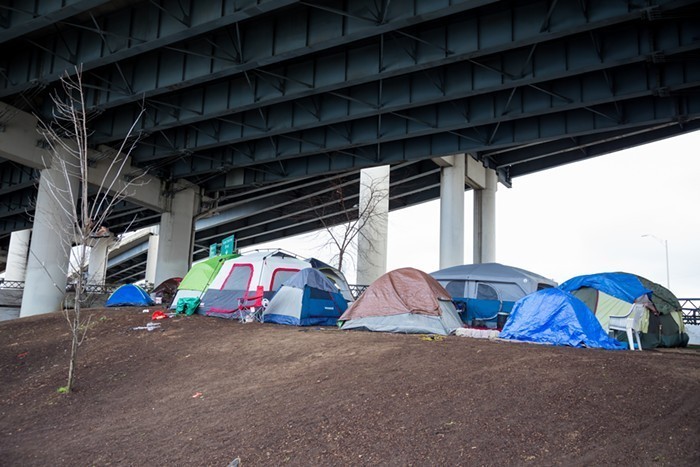
By April, Wilson was declaring in his State of the City address: “We cannot afford to return to an era where we found death in tents, under tarps, behind dumpsters, and beneath bridges. Those days are long gone.”
Into all of this, Portland’s Housing Bureau — which was sitting on over $100 million for years while the crisis built — is allocating $200,000 for landlord and tenant education.
Not legal aid. Not emergency rental assistance. Not preventing a single eviction directly. A budget roughly equal to what it costs to rehouse seven unhoused adults for one year, spent instead on informational programming to fill the space left by the organizations the state just defunded.
The mayor says those days are long gone. The data says otherwise. And the money says who we actually believe.
Who Benefits? We Looked.
When a story like this breaks, the first question a lot of people ask is: who was getting paid to look the other way?
It’s a fair question. We looked into it seriously — and here’s what the record actually shows.
The three main administrators at the center of this — Deputy City Administrator Donnie Oliveira, CFO Jonas Biery, and former City Administrator Michael Jordan — are career public servants. Oliveira came up through San Francisco’s environmental and planning offices. Jordan spent 40 years moving through public roles: city manager, county commissioner, COO of Metro, COO of the state of Oregon. Neither has documented real estate investment ties that would create a personal financial motive to suppress housing funds.
Biery is more interesting. Before returning to the city in 2024, he spent four years as a Vice President of Public Finance at D.A. Davidson & Co., a firm that has an explicit real estate development finance division and has structured hundreds of public financing deals. That’s a significant revolving door between private development finance and the city’s top budget position. It doesn’t prove anything on its own. But it shapes what kinds of deals feel normal and what kinds of questions feel worth asking.
We didn’t find a smoking gun. What we found instead was a pattern.
The same two administrators who sat on the housing money — Oliveira and Biery — are also the ones secretly running the Moda Center deal.
OPB and the Oregonian revealed in April 2026 that city officials had been holding weekly closed-door meetings since at least November 2025 under the code name “Project Mt. Hood” to negotiate a $400 million-plus public financing deal for the Trail Blazers arena. Participants included Biery, Oliveira, and Mayor Wilson’s chief of staff. Oliveira also personally flew to North Carolina on a city-funded trip to tour arenas in Charlotte and Raleigh, studying how other cities structured full public funding packages for private sports teams.
The Oregon Legislature has already approved $365 million in state bonds for the arena. The city is now expected to add hundreds of millions more. Some councilors found out about the city’s arena commitments the same way the public did: through press releases. Councilors Tiffany Koyama Lane and Mitch Green publicly refused to sign NDAs that would have given them access to the negotiations. Green wrote: “If you want the public to support using public money to remodel a stadium, then you need to make the case to them in public.”
Sound familiar?
The same administrators who told housing advocates there was no money — who disclosed $100 million in housing funds an hour before a budget vote, who told a housing bureau director that disclosing unspent tenant protection money would be “a big PR problem” — those same people have been in weekly secret meetings about how to deliver hundreds of millions in public money to a billionaire sports team owner.
Tom Dundon, the Blazers’ new owner, made his first fortune in subprime auto loans that Oregon regulators once publicly called “predatory and harmful.” He now wants full public funding for arena renovations after his group paid $4.25 billion for the team. He got $365 million from the state legislature — the same session that refused to restore even $4 million for eviction prevention.
We’re not claiming these administrators personally profit from the arena deal. We’re saying: watch where the energy goes. Watch what gets secret weekly meetings and code names, and what gets disclosed an hour before a vote. Watch what gets called “a big PR problem” and what gets called a priority.
The money always goes somewhere. The question is who it’s going toward.
What To Do With This
The oversight hearing may not be over. Councilor Green said he was not satisfied and that more oversight may be in order. The Council’s budget process is happening right now, with a new $160 million shortfall looming and the same dynamic playing out: administrators instructing staff not to engage directly with councilors.
The city budget office that might have caught this housing funds gap? The mayor’s proposed budget cuts it by $562,000 and eliminates three full-time positions. The CFO said it himself at the April hearing: “We will continue, I predict, to see these kinds of anomalies for the long term until we get serious about investing in that administrative infrastructure.” The Moda Center negotiations, meanwhile, have a dedicated weekly meeting with that same CFO.
If you want to pay attention and push back, here’s where to start:
- Follow the full $145 million. Council approved a plan for $56 million. That leaves roughly $89 million still being debated. Watch what happens to it.
- Watch the budget office cuts. If the city is serious about catching these gaps, it cannot simultaneously gut the office that catches them.
- Ask your councilor what accountability measures are being put in place to prevent this from happening again — not just “we’ll communicate better,” but structural changes.
- Show up to budget hearings. The current budget process is live and the public can testify.
The signal fires are already lit. Pay attention to where the smoke is.
Sources and supporting links: Portland Mercury oversight hearing coverage · OPB: Portland approves plan to spend $56 million · OPB: Portland now says roughly $106M in housing funds went unspent · Portland Mercury: $21 million funding bump · Portland.gov: Council resolution on $20.7M allocation · Street Roots: Oregon lawmakers refused calls to restore eviction prevention funding · OPB: Behind Portland’s homelessness data · OPB: Trail Blazers public funding lobbying · KGW: City Council divided over Moda Center NDAs